1031 Exchange News & Insights

Unlocking the Potential of the 721 Exchange

December 05, 20254 min read

Investment property owners are continually seeking tax-efficient strategies that preserve long-term wealth while also offering potentially attractive returns. One strategy that has been gaining popularity among private real estate investors is the 721 exchange.

A Tax-Efficient Exit Strategy for Real Estate Investment Property Owners

Internal Revenue Code 721 enables property owners to contribute real property in exchange for interests in an operating partnership of a real estate investment trust (REIT) that is structured as an umbrella partnership real estate investment trust, or UPREIT. The benefits of exchanging properties into an UPREIT range from tax deferral of capital gains to converting to passive income streams. In this blog, we explore the 721 exchange/UPREIT transaction, its appeal, the intricacies of the exchange process, and its potential benefits and limitations.

The Appeal of the 721 Exchange

A few key factors making the 721 exchange/UPREIT strategy appealing include:

  • Tax-Deferral Structure: One of the primary draws of the 721 exchange is the ability to defer capital gains tax. By participating in a 721 exchange, a taxpayer can postpone the tax liability that would typically arise from selling the property outright. By maintaining the sale proceeds that would otherwise be paid out in taxes, more funds are available for reinvestment.

  • Passive Income: Owning real estate often comes with the responsibilities of property management, which can be both time-consuming and challenging. The 721 exchange allows a property owner to enjoy the benefits of real estate ownership without the hassles of day-to-day management. They become a passive investor in the portfolio.

  • Portfolio Diversification: Spreading risk across multiple institutional-quality properties is a cornerstone of a sound investment strategy. Through the 721 exchange, property owners may gain exposure to a diversified range of properties managed by experienced professionals, reducing the risk associated with individual property ownership.

  • Professionally Managed Assets: The expertise of institutional real estate managers can make a significant difference in the performance of your clients’ investments. Through a 721 exchange, they can potentially tap into the skills and knowledge of seasoned real estate professionals who handle property selection, management, and optimization.

  • Liquidity: Liquidity is a crucial factor in any investment strategy. UPREIT structures may provide investors with a redemption option, providing them access to liquidity.

Understanding the 721 Exchange Process: A Case Study

Let's walk through the step-by-step process of a 721 exchange. Suppose an investment property owner (Steve) is looking to sell his investment properties. He has several motivations and goals driving this decision.

  1. Steve has owned his rental properties for years, and he is tired of the hands-on management and upkeep they require.

  2. He wants to continue to own real estate but is looking for a passive ownership opportunity.

  3. Steve’s properties have appreciated in value significantly, and he wants to avoid paying capital gains tax.

  4. He would like to own a broad portfolio of high-quality commercial real estate diversified by property type and geography.

  5. Finally, he would like to increase his liquidity options while also maintaining his step-up basis for estate-planning purposes.

Steve is looking for a tax-efficient investment strategy that preserves wealth while offering strong returns. He sees investing in an UPREIT through a tax-deferred 721 exchange as a potential solution. However, a key challenge he faces is that, likely, most, if not all, large institutional REITs will not acquire individual properties or small portfolios, leaving Steve to wonder how he can align his investment goals with the strategic investment thesis of the UPREIT.

The 721 Exchange via Delaware Statutory Trust (DST)

Steve’s in luck! He may still achieve his goal of transforming his investment property into ownership in an UPREIT on a tax-deferred basis through a combination 1031/721 exchange using a DST as a conduit. Combining a 1031 exchange with 721 is an elegant solution allowing investors to transform investment property into operating partnership units.
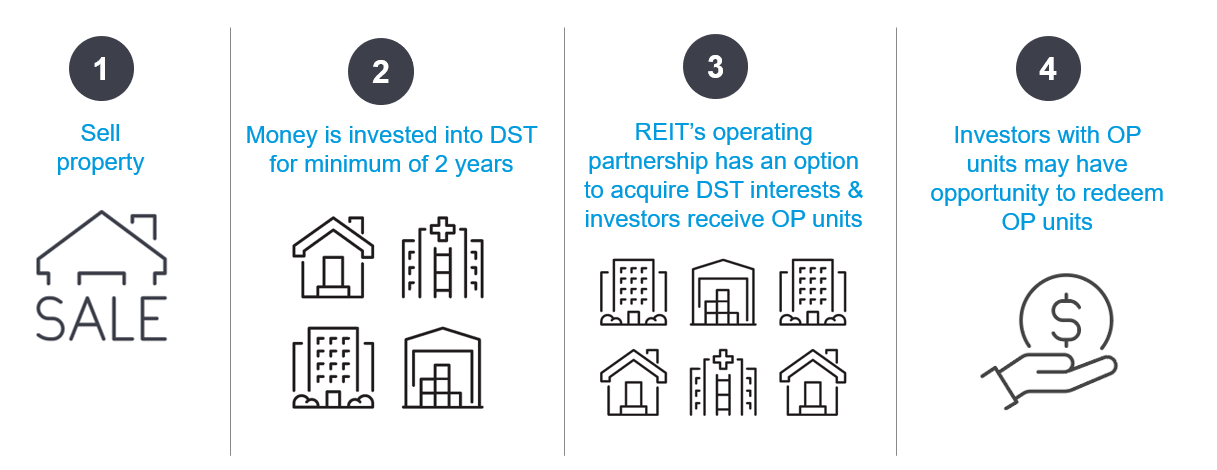
721 Exchange Steps Image
  1. To complete this type of exchange, Steve first sells his investment properties and invest his proceeds into a DST that is designated for a 1031/721 program.

  2. In the case of 721 DSTs there is typically a shorter hold period than traditional DSTs and average at least two years.

  3. At the end of the hold period, and assuming the REIT exercises its option to acquire the assets of the DST, Steve’s interests in the DST will be exchanged for OP Units of the REIT - completing the 721 portion of the exchange.

  4. After holding OP Units for one year, Steve has the option to access liquidity through the UPREIT’s redemption program. However, capital gains tax may be due when his OP units are redeemed for cash or converted to REIT shares.

Ultimately, Steve decides (for estate-planning purposes) to bequest equal amounts of this OP Units to his son and daughter. This allows them to receive the step-up basis and enabling them to make their own decision of whether they want to remain invested while still deferring the original capital gains tax or redeem their OP Units, which again is a taxable event.

The hypothetical described above is only one example of the potential benefits a 721 exchange transaction can offer real estate investment property owners. As the trend toward this strategy continues gaining momentum, it's important for investors to be aware of all regulations and potential limitations associated with this sophisticated investment strategy. Consult a knowledgeable financial professional regarding how a combination 1031/721 via DST transaction may impact investment goals.

Gerald F. "Jerry" Baker, III is the founder of Baker 1031 Investments, a firm built from firsthand experience navigating the intersection of institutional finance and generational family real estate. Jerry has experience working for some of the nation's most reputable real estate private equity firms and hedge funds. Over his career, he has been involved with more than $10 Billion worth of real estate activities.

Jerry Baker

Gerald F. "Jerry" Baker, III is the founder of Baker 1031 Investments, a firm built from firsthand experience navigating the intersection of institutional finance and generational family real estate. Jerry has experience working for some of the nation's most reputable real estate private equity firms and hedge funds. Over his career, he has been involved with more than $10 Billion worth of real estate activities.

Back to Blog

Access Available 1031 DST Property Listings

Baker 1031 Investments LLC is a real estate securities investment broker, focused on investment solutions for real estate investors in 1031 exchanges. As a result of the firm's focus on providing custom investment solutions to their clients, Baker 1031 Investments is the chosen investment firm by nearly 30% of sophisticated real estate investors. ¹

Contact

+1 (415) 579-1660

650 California Street, 7th Floor

San Francisco, CA 94108

Legal

Terms & Conditions

Privacy Policy

Aurora Securities Form CRS

Get started in less than 5 minutes.

The information herein has been prepared for educational purposes only and does not constitute an offer to purchase or sell securitized real estate investments. Such offers are only made through the Sponsor’s Private Placement Memorandum (PPM) which is solely available to accredited investors and accredited entities. DST 1031 properties are only available to accredited investors (generally described as having a net worth of over $1 million dollars exclusive of primary residence) and accredited entities only. If you are unsure if you are an accredited investor and/or an accredited entity, please verify with your CPA and Attorney.

There are material risks associated with investing in DST properties and real estate securities including liquidity, tenant vacancies, general market conditions and competition, lack of operating history, interest rate risks, the risk of new supply coming to market and softening rental rates, general risks of owning/operating commercial and multifamily properties, short term leases associated with multi-family properties, financing risks, potentially adverse tax consequences, general economic risks, development risks, long hold periods, and potential loss of the entire investment principal. Potential cash flows/returns/appreciation are not guaranteed and could be lower than anticipated.

Diversification does not guarantee a profit or protect against a loss in a declining market. It is a method used to help manage investment risk. Because investor situations and objectives vary this information is not intended to indicate suitability for any particular investor. This material is not to be interpreted as tax or legal advice. Please speak with your own tax and legal advisors for advice/guidance regarding your particular situation.

Securities offered through Aurora Securities, Inc. (ASI), member FINRA/SIPC. Baker 1031 Investments (Baker 1031) is independent of ASI. To access Aurora Securities’ Form Customer Relationship Summary (CRS), please click HERE. Baker 1031 Investments, Jerry Baker, and (ASI) do not offer legal or tax advice. Please consult the appropriate professional regarding your individual circumstances.

Client examples are hypothetical and for illustration purposes only. Individual results may vary.

This site is published for residents of the United States only. Representatives may only conduct business with residents of the states and jurisdictions in which they are properly registered. Therefore, a response to a request for information may be delayed until appropriate registration is obtained or exemption from registration is determined. Not all services referenced on this site are available in every state through every advisor listed. For additional information please contact +1 415 579 1660 or email [email protected].

¹ The statement that "Nearly 30% of all experienced real estate investors " is a market share estimate derived from an analysis of third-party market data as of October 2025, representing the proportional relationship between the Baker 1031 Investment investor database and an estimated total market of active real estate investors; this estimate is based on Crexi reporting a 2,000,000 user base, 80% of whom are assumed not to be agents/brokers, and 42% of activity dedicated to investment sales, from which a conservative assumption excludes 15.7% as non-investor service providers (e.g., appraisers, lenders), resulting in an estimated active investor market of 566,664; as the Baker 1031 Investment database comprises over 170,000 individuals or entities, this figure represents 30.00% of the estimated market.

The figures and calculations provided constitute a market share estimate based on unverified third-party data and internal assumptions utilized to define the estimated market; Baker 1031 Investment has not independently verified the accuracy of the underlying data, and the term "experienced real estate investors" is defined exclusively by this methodology and its internal assumptions. This communication is not a guarantee of future results, a testimonial, or a statement of performance for any investment product or service, and its accuracy is subject to the inherent limitations of the underlying data and the validity of the internal exclusion assumptions.

² ³ ⁴ ⁵ The calculated platform averages presented reflect a statistical average of data provided by the specific investment sponsors listed here. The figures used in these averages are collected from self-reported statistics provided directly by the respective firms within their Private Placement Memorandums (PPMs). This information is provided solely for illustrative and educational purposes and is not intended to serve as the basis for any investment decision, nor does it constitute investment advice, a recommendation, or an offer to sell or a solicitation of an offer to buy any security. All data presented is as of November 6, 2025. Due to the nature of self-reporting, the data presented may be incomplete, unverified, or subject to correction, and we make no representation or warranty as to its accuracy, completeness, or timeliness. Past performance is not indicative of future results, and all investments involve risk, including the possible loss of principal. The platform average represents a limited sample, and results from individual sponsors may vary materially. For complete underlying data, data from other investment sponsors, and/or additional detail, please contact us directly. The selection of results shown are a small fraction of the total amount of realized investments and are not guarantees of future results. There are often differences between the performance results and the actual results shown and other investments' outcomes. Delaware Statutory Trust (DST) investments are subject to volatility and loss of investor principal.

⁶ ⁷ ⁸ ⁹ ¹⁰ ¹¹ ¹² Baker 1031 Investments performance data per disclosure points 2 through 5, above. S&P 500 data per St. Louis FRED, all-time average S&P 500 data. “Low Fee” DST data per Origin Investments Growth Fund III, accessed November 6, 2025. Privately Owned Real Estate data per Fundrise, accessed November 6, 2025. Other DST Firms data per Inland historical returns, accessed November 6, 2025. Institutional Real Estate per Invesco Active U.S. Real Estate ETF accessed November 6, 2025. Real Estate Crowdfunding data per Fundrise, accessed November 6, 2025.